
Moving to Canada can involve a significant amount of paperwork, and the documents required by Immigration, Refugees and Citizenship Canada (IRCC) depend on the immigration program and the applicant’s individual circumstances.
While requirements vary between programs, many applications require documents that establish identity, family status, education, employment history, financial circumstances and admissibility. Express Entry applicants, in particular, receive a personalized document checklist based on the information provided in their application.
Start With What IRCC Needs to Verify
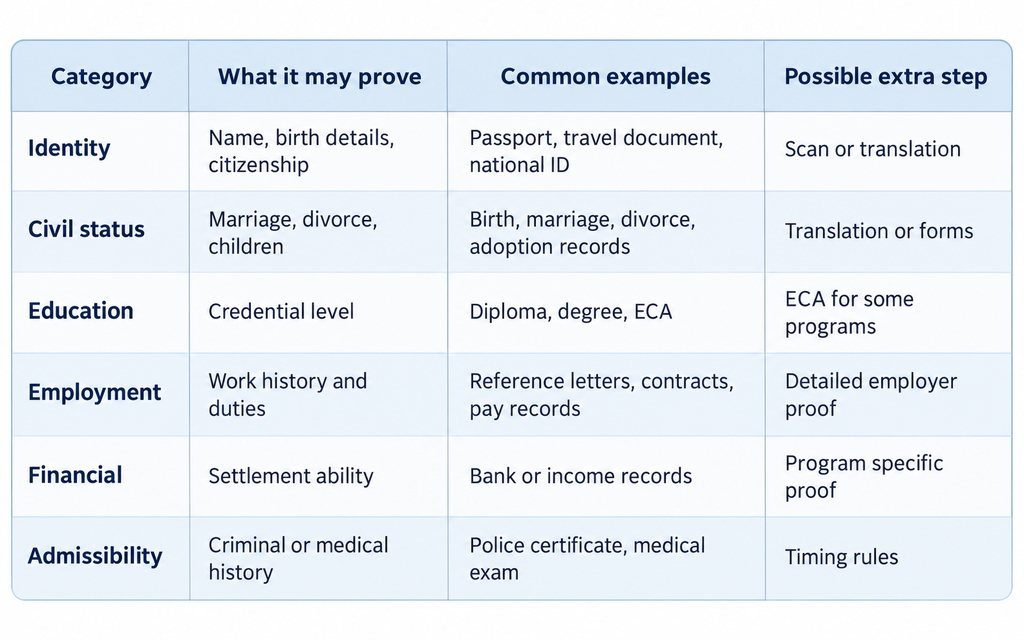
A passport supports identity and citizenship, a marriage certificate supports marital status, an Educational Credential Assessment can confirm the Canadian equivalency of foreign education, and employer records can support claimed work experience. When a record is in another language, preparation may include both the source document and a translation. rapidtranslate.org provides certified document translation, while the applicant still needs to follow the instructions for the specific IRCC program being used.
Identity and Family Status Documents
Identity Records
IRCC commonly uses a passport or travel document to confirm an applicant’s identity and personal information.
For Express Entry, IRCC advises applicants to renew a passport that will expire within six months of applying. Once the new passport is issued, the updated passport information should be added to the application.
Applicants should also carefully check names, dates and other personal information across their documents and application forms to ensure the information submitted is accurate.
Marriage, Children and Civil Status
The family and civil-status documents required depend on what is declared in the application.
For an Express Entry permanent residence application, supporting documents may include a marriage certificate, divorce certificate or legal separation agreement, death certificate, dependent child’s birth certificate, common-law union form or adoption certificate.
The personalized document checklist provided by IRCC is particularly important because it reflects the information supplied by the applicant and identifies which supporting records need to be uploaded.
Education and Employment Evidence
Education Documents
Applicants with education completed outside Canada may need an Educational Credential Assessment (ECA).
An ECA is used to verify that a foreign degree, diploma, certificate or other credential is valid and determine its Canadian equivalency.
Under Express Entry, an ECA is generally needed when foreign education is being used to qualify as the principal applicant under the Federal Skilled Worker Program or to claim points for education completed outside Canada.
An ECA is not required for a Canadian degree, diploma or certificate. Applicants should check the requirements of their particular immigration program before arranging an assessment.
Work History
Employment records can be used to confirm an applicant’s employment history and claimed work experience.
Depending on the immigration program and document checklist, evidence may include employment contracts, pay stubs, employer reference letters and tax documents.
Employer reference or experience letters can be particularly important for Express Entry applicants. Where required, supporting documentation may need to establish details such as the dates of employment, job duties, salary and other information relevant to determining whether the claimed work experience meets program requirements.
Applicants should therefore check the requirements for their particular program rather than assuming that a single piece of employment evidence will always be sufficient.
Police Certificates, Funds and Supporting Proof
Police Certificates
Police certificates are an important part of the permanent residence process because they help IRCC determine whether an applicant may be inadmissible to Canada.
For Express Entry permanent residence applications, the online system generally requests police certificates for the applicant and family members aged 18 or older for countries where they stayed for six consecutive months or longer during the previous 10 years. Time spent in a country before the age of 18 generally does not require a police certificate.
For the country where an applicant currently lives, the police certificate generally must have been issued no more than six months before the application is submitted. IRCC may also request updated police certificates during processing.
Requirements are different for countries where an applicant previously lived, so applicants should review IRCC’s country-specific and Express Entry instructions carefully.
If an Express Entry applicant cannot obtain a required police certificate before the application deadline, IRCC allows them to provide a letter of explanation along with evidence showing their efforts to obtain the certificate. An immigration officer will then determine whether that evidence is sufficient.
Proof of Funds
Proof of funds is required only for immigration programs and applicants for which the requirement applies.
IRCC uses this evidence to determine whether an applicant has enough money available to support themselves and accompanying family members after arriving in Canada.
The amount and type of evidence required can vary according to the immigration route and family size. Applicants should therefore check the current requirements for their specific program rather than relying on a general financial threshold.
Medical Exams
Permanent residence applicants may also need an immigration medical exam.
When an immigration medical exam is required, it must be completed by an IRCC-approved panel physician. Applicants should follow the current instructions for their application type when determining how and when to complete the exam.
Translation, Copies and the Final Check
When a Translation Is Required
For Express Entry permanent residence applications, documents that are not in English or French must be accompanied by an English or French translation and the appropriate copy of the original document.
When a certified translator completes the translation, the translator must meet IRCC’s certification requirements. IRCC defines a certified translator as a member in good standing of a professional translation association in Canada or abroad, with certification confirmed by a seal or stamp showing the translator’s membership number.
If a translation cannot be completed by a certified translator, IRCC provides an affidavit process under specified conditions.
Stamps and seals that are not in English or French must also be translated. Applicants, their family members and certain representatives or consultants cannot translate the documents themselves for IRCC purposes.
Certified Photocopies
A certified photocopy is different from an ordinary photocopy or scan.
IRCC defines a certified photocopy as a readable copy that has been compared with the original document and certified as a true copy by an authorized person.
Who is permitted to certify a document can depend on where the certification takes place. Applicants should check the applicable IRCC instructions and local requirements before having documents certified.
A Practical Submission Sequence
A useful starting point is the personalized IRCC document checklist.
Applicants can then gather the requested records, identify documents that are not in English or French, arrange any required translations or certifications and prepare clear electronic copies in the required format.
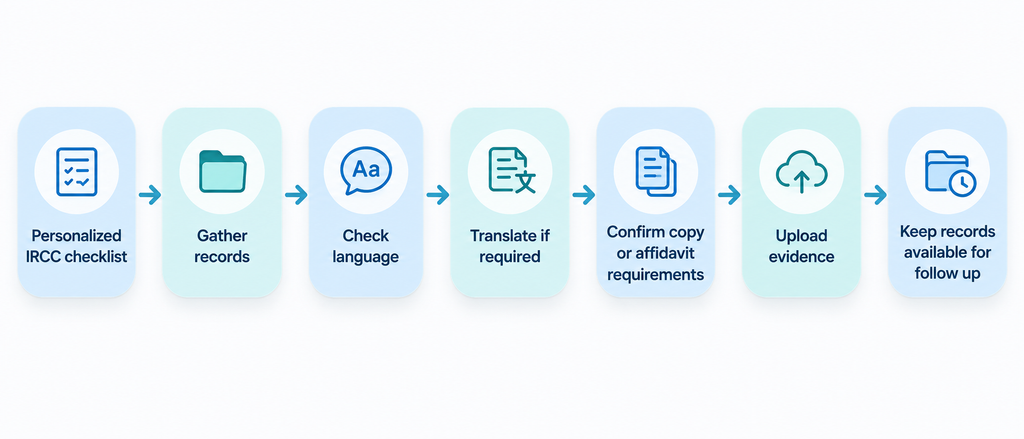
Before submitting an application, each file should be checked against the current instructions for the specific immigration program.
General IRCC guidance can help applicants prepare, but immigration programs do not all have identical documentation requirements. The personalized checklist and current program instructions should therefore take priority over general advice.
IRCC may also request additional documentation during processing.
Conclusion
Managing Canadian immigration documentation becomes easier when applicants understand what each record is intended to establish.
Depending on the immigration program, documents may be needed to establish identity, family status, education, employment history, finances and admissibility. Documents that are not in English or French may also require translation that meets IRCC requirements.
Because requirements vary by immigration route and individual circumstances, applicants should use current IRCC instructions and their personalized document checklist as the primary sources when preparing an application. Taking the time to verify each document before submission can help avoid preventable omissions and delays.
What say you?
Thoughts on IRCC Document Requirements?
Let’s hear it!